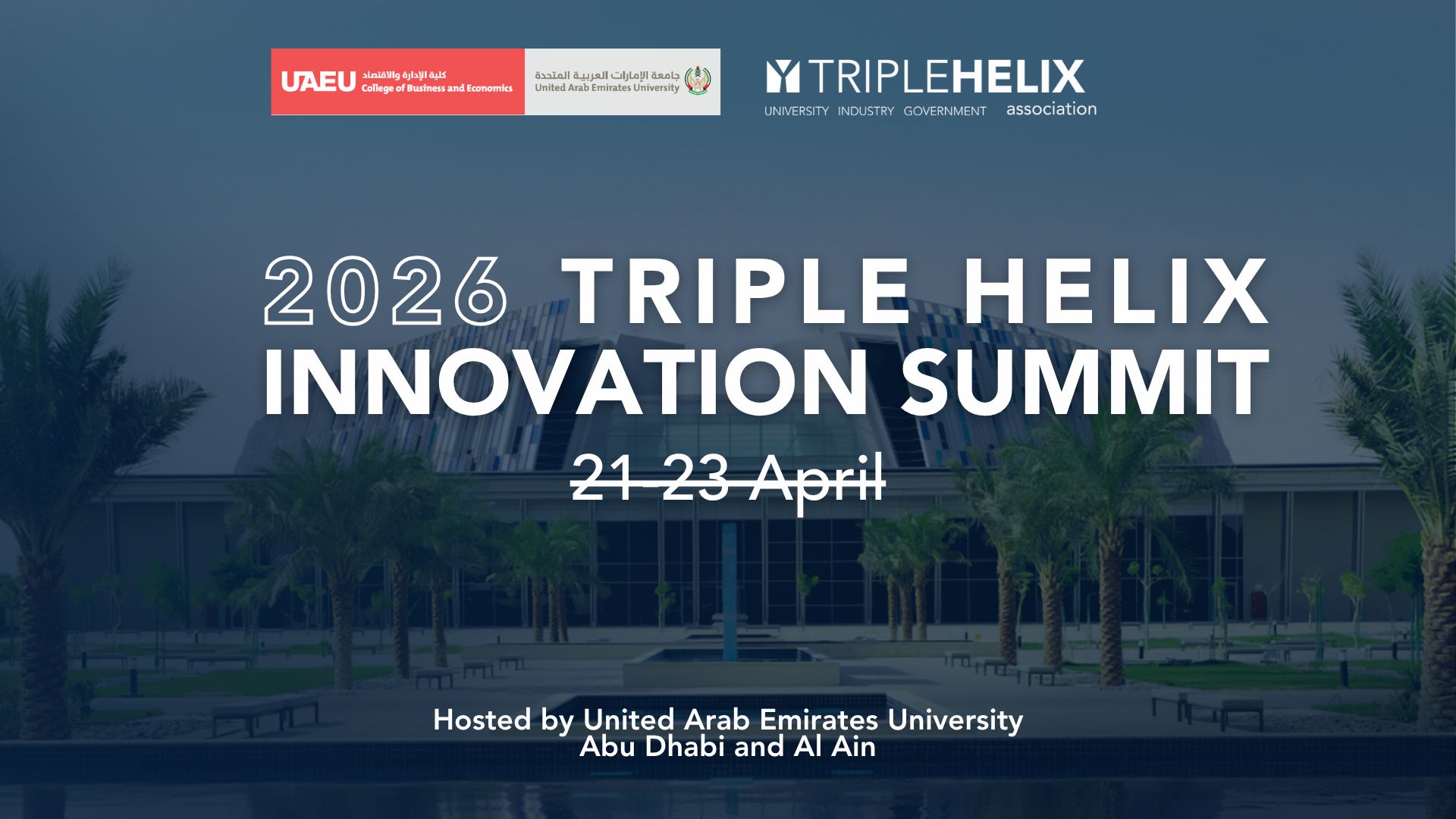
Triple Helix Innovation Summit 2026 postponed
Due to recent geopolitical circumstances and logistical constraints beyond the organizers’ control, the event scheduled for April 2026 has been postponed. A new date is under consideration, possibly in April 2027. Further updates will be published on this website.
Artificial Intelligence and the Triple Helix: Shaping Innovation Ecosystems for Sustainable Futures
Artificial intelligence is fundamentally transforming how societies solve their most pressing challenges. Yet AI’s impact depends not only on technology alone, but also on how governments, universities, and industry collaborate in society to harness its power responsibly and equitably.
Innovation comes from new and unexpected places, as well as old ones. It is used in both old and new ways in industry, startups, society, and we need governments to support the free flow, use, and interaction of ideas, and to provide the framework for a just and sustainable transition from the past to the future.
The 2026 Triple Helix Innovation Summit, hosted by the United Arab Emirates University, brings together global leaders, innovators, industry, and policymakers to explore this critical collaboration at a decisive moment in history and how the lessons of our past can inform innovation in the age of artificial intelligence.
The Context: A World at an Inflection Point
Nations worldwide are racing to define their place in the emerging digital and sustainable economy. From the UAE's National Innovation Strategy and the UAE 2031 vision to comparable ambitious policies across the MENA region, Europe, Asia, Africa, and the Americas, governments are embedding AI into their core development strategies.
Yet questions remain: How can we ensure that AI-driven innovation strengthens resilience and justice, not just competitiveness? What governance models will balance opportunity with responsibility? How do we integrate regional innovation efforts into a global conversation to catalyze socio-economic innovation ecosystems across regions?
Set in Abu Dhabi for the first two days with field visits to Al Ain in the third day — two cities where ancient heritage meets cutting-edge data-driven progress — the Summit reflects on how societies have navigated previous technological disruptions, how they are approaching the new opportunities and challenges, and what these experiences can teach us as we shape AI-driven futures.
Drawing inspiration from current evolutions and historical innovators, cultural heritage, and the global policy momentum surrounding AI, the Summit reimagines the Triple Helix model not only as a framework for collaboration but also as a bridge across time, culture, and technology.
Why Attend?
The Summit places the Triple Helix model, which represents the dynamic interaction among academia, industry, and government, at the center of the global AI debate. Over three immersive days in April 2026, you will:
1. Learn from global leaders as policymakers, innovators, and researchers share how AI is reshaping national strategies in energy, mobility, health, education, water, technology, and space across diverse regions and governance contexts.
2. Engage in comparative analysis through plenary sessions, case studies, and field visits that examine different approaches from the Gulf to Europe to Asia, revealing what works in different cultural, economic, and political environments.
3. Discuss the Triple Helix as a governance model and explore whether it is designed to manage AI’s opportunities and risks, from regulation-heavy frameworks to principle-based and experimental approaches, and discover how your organization can adapt such insights.
4. Build strategic Triple Helix partnerships across system boundaries, sectors, and borders through interactive sessions, working groups, and networking opportunities that foster collaboration on shared challenges, such as climate action, smart cities, and digital transformation.
5. Shape policy and practice by contributing your expertise to conversations that will inform how AI ecosystems evolve and what transformational governance is needed for a just transition from past to future - by connecting with decision-makers who are implementing change today.
Who Should Attend?
This Summit is designed for senior leaders and innovators and scientists of all faculties who shape their organizations’ AI strategies and innovation agendas: government policymakers and innovation officers; university leaders, researchers, scholars, and entrepreneurs; corporate executives and innovation heads; international development specialists; and NGOs and civil society organizations focused on technology, sustainability, and social impact. Triple Helix community and scholars are welcome to contribute their ideas to advance the Triple Helix concept.
Connect with Purpose
By attending the 2026 Triple Helix Summit, you join a global community committed to ensuring that AI, in combination with TH governance, serves not only innovation and economic growth but also contributes to greater resilience, justice, and sustainability. Together, we will explore how collaboration between universities, industry, and government can create and sustain innovation ecosystems that benefit all societies and help address humanity’s most pressing challenges.
The 2026 Triple Helix Innovation Summit: Where innovation meets responsibility, and collaboration shapes the future.
📧For more information, please contact us at: info@triplehelixassociation.org
Get to know the United Arab Emirates University
Source: UAEU
PRELIMINARY PROGRAM
DAY 1 - APRIL 21, 2026
08:00 | Starting Registration
09:30 – 10:15 | Opening Session
- Welcome remarks (UAEU, THA, Government representative)
- Keynote: AI, Innovation, and the Future of Triple Helix Collaboration Worldwide
10:15 – 11:30 | Plenary 1 – AI & National Priorities: Comparative Global Perspectives
- How governments worldwide embed AI into their national innovation strategies.
- Shared priorities: energy transition, healthcare, water/food security, smart mobility, space, digital government.
- Contrasting governance models: regulation-heavy vs. principle-based vs. experimental.
11:30 – 12:00 | Coffee Break
12:00 – 13:15 | Plenary 2 – The future meets the past: lessons from historical disruptions and AI-driven industrial transformations
- Revisiting previous waves of disruption — from industrial revolutions to the digital age.
- AI-Driven industrial productivity and competitiveness
- Cases from Europe, Asia, and the Gulf to reflect on differences and commonalities
13:15 – 14:15 | Lunch
14:15 – 15:30 | Parallel sessions
15:30 – 16:00 | Coffee Break
16:00 – 17:15 | Parallel sessions
19:30 – 21:30 | Gala Dinner
DAY 2 - APRIL 22, 2026
09:00 – 10:15 | Plenary Session 3 – AI and Cultural Heritage: Digitalizing the Past for the Future
- Preserving and reinterpreting cultural heritage in the age of AI.
- Case studies on digitization, immersive heritage technologies, and cultural innovation.
- Discussing identity, ethics, and data sovereignty through a Triple Helix lens.
10:30 – 11:45 | Plenary Session 4 – AI for Climate Action and Global Sustainability
- AI for energy transition, carbon tracking, and sustainability disclosure
- Predictive climate analytics and partnerships for net-zero innovation
- Green finance, impact investment, and sustainable investment
12:00 – 13:15 | Lunch
13:15 – 14:30 | Parallel sessions
14:30 – 15:00 | Coffee Break
15:00 – 16:15 | Parallel sessions
16:30 – 17:30 | Closing Session
- What Have We Learned? Reflections from global participants.
- Closing remarks
DAY 3 - APRIL 23, 2026
Full day dedicated to visit Al Ain combining visits to UAEU, historical sites and companies
VENUE
Millennium Al Rawdah Hotel
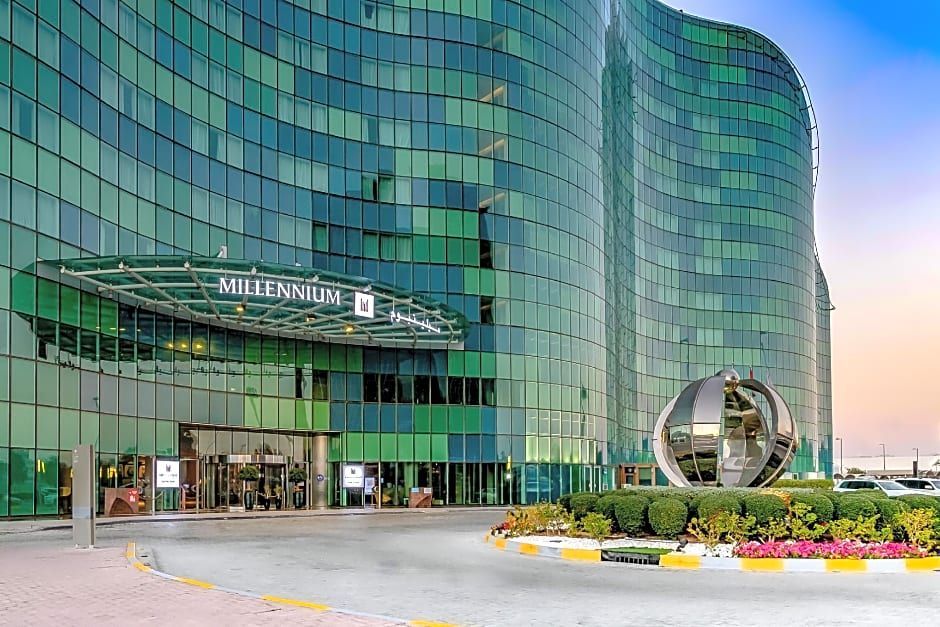
1778 Sheikh Rashid Bin Saeed St - Al Rawdah - W68 - Abu Dhabi - United Arab Emirates
Get to know Abu Dhabi
Source: Visit Abu Dhabi
CALL FOR PAPERS
The United Arab Emirates University (UAEU) invites scholars, practitioners, and policymakers to submit contributions to the 2026 Triple Helix Innovation Summit, to be held in the United Arab Emirates. The Summit examines how universities, industry, government, and, where relevant, civil society and the environment, co-create, govern, and deploy artificial intelligence (AI) to build resilient, competitive, and inclusive innovation systems.
AI is reorganizing knowledge production, markets, public services, and civic life. Triple Helix approaches linking institutional spheres, hybrid organizations, boundary-spanning roles, and “knowledge/consensus/innovation” spaces offer a proven grammar for navigating this transformation.
We seek work that shows how AI reshapes the entrepreneurial university and the third mission, retools technology transfer and open innovation, enables mission-oriented policies, and demands new governance models (from regulatory sandboxes to principle-based oversight). Comparative analyses across regions and sectors are particularly welcome, as are contributions that extend to Quadruple/Quintuple Helix perspectives (including civil society and the environment) where appropriate.
Tracks & Topics
Select one primary track for your submission and incorporate cross-cutting lenses in your abstract:
Track 1 - AI, Governance & Triple Helix Design
AI is forcing institutions to rewire their approach to cooperation, regulation, and learning. This track examines how universities, industry, government, and, where relevant, civil society, can develop adaptable governance that fosters experimentation while safeguarding rights and promoting competition.
Track 2 - Transformative Entrepreneurship in the AI Era
Generative and predictive AI are collapsing the time from idea to viable product. This track examines how founders, incubators, and investors adapt venture design, evidence-based training, and market validation in the era of copilots, synthetic data, and automation. We invite work that demonstrates Triple Helix partnerships transforming technical capabilities into scalable, responsible ventures.
Track 3 - The Entrepreneurial University, Academic Innovation, & Human Capital
This track examines how TTOs, research contracts, and open-science infrastructures evolve when AI pervades the discovery and commercialization process and how Triple Helix models contribute to shaping new trajectories. We welcome frameworks and cases where university–industry–government orchestration accelerates third-mission impact without diluting academic integrity. We are especially interested in designs that expand participation, e.g., women’s entrepreneurship or underserved regions, that demonstrate measurable outcomes of inclusion.
Track 4 - Sustainability, Climate & the Future Economy
From grid optimization to climate risk analytics, AI is becoming core infrastructure for the transition. This track looks at Triple Helix collaborations that translate models into measurable decarbonization, circularity, and ESG performance, especially in emerging economies and hard-to-abate sectors. Bring cases and evidence that link science, financing, and policy into investable pathways.
Track 5 - Culture, Heritage, Cities & Society
AI can preserve memory and reinvent place while raising profound questions about identity and stewardship. This track welcomes work on digital heritage (twinning, ML restoration, immersive media), city governance and digital public services, as well as community co-creation. We seek evidence of experiences that co-produce culturally respectful and economically vibrant outcomes among government, universities, and firms.
Track 6 - Comparative & Regional Perspectives
Innovation systems differ in terms of their history, institutions, and risk appetite. This track focuses on comparative analyses of AI strategies and Triple Helix practices across regions: the Gulf, Europe, Asia, Africa, the Americas, to distill what transfers, what must adapt, and why. Submissions should clearly outline the mechanisms in place, including intermediaries, incentives, standards, and the metrics that demonstrate impact.
Submission Types
Extended abstracts (1000 words) can be submitted for the following:
• Research papers, Policy/practitioner briefs with actionable frameworks, toolkits, or Case studies using the Google Forms link below.
Review Criteria
• Fit with the theme and with Triple/Quadruple/Quintuple Helix approaches
• Originality and rigor; clarity of methods and implications
• Practical relevance and transferability; engagement with ethics/society/sustainability
• Coherence with chosen track and use of cross-cutting lenses
Indicative Timeline
• NEW abstract submission deadline: March 10th
• NEW notification of acceptance: March 20th
• Author registration deadline: April 2nd
• Summit dates: April 21st – 23rd, 2026
Presentation & Program
Accepted abstracts will be scheduled for either oral or poster presentations within their respective tracks.
How to Submit
Prepare your extended abstract using the structure below and copy and paste it into our Google Form by clicking on the button below.
- Paper Title
- Names of Author(s) and Affiliations
- Paper Type
- Summit Track
- Purpose/Objective
- Method
- Findings
- Originality
- Practical/Social Implications
- Direction for Future Research/Limitations
- 3 – 5 keywords
- References
📧 If you encounter any problems with your submission, please send an email to: ecer@uaeu.ac.ae
REGISTRATION
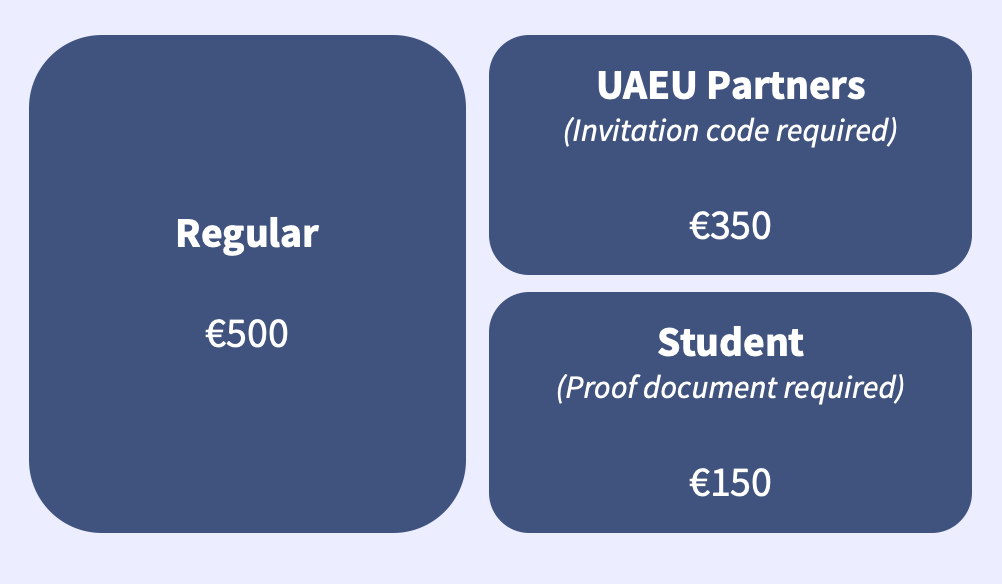
Triple Helix Association Members
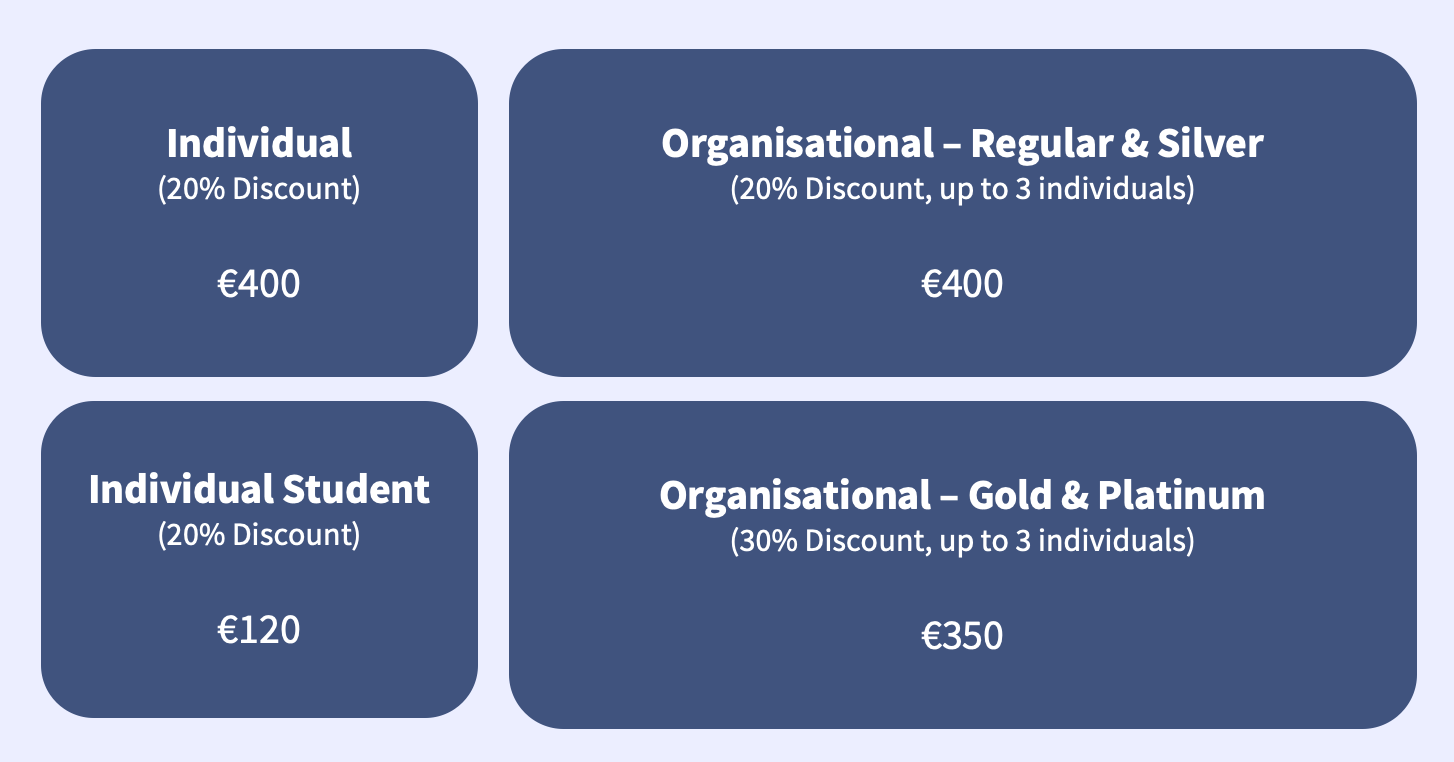
Interested in becoming a Triple Helix Association member?
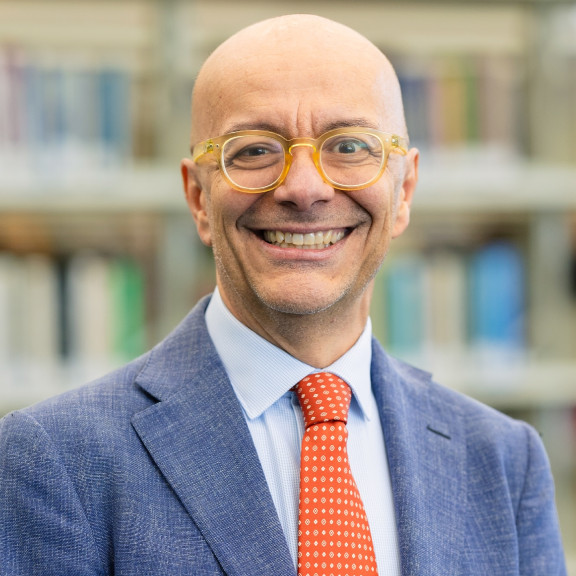
Prof. Maurizio Sobrero
Chair
Maurizio Sobrero, Ph.D. (MIT), is the Director of the Emirates Center of Entrepreneurship Research at CBE. During his service at the University of Bologna, Italy, he chaired the PhD Program in Management, the Department of Management, the Council of the University Department’s Chairs, the University Research Committee, was a member of the University Senate, and a member of the University’s Executive Committee. He is the author of over 30 top-tier peer-reviewed international articles and 5 books on Entrepreneurship and the Economics and Management of Innovation. He has served as an expert in these matters in several Committees of different public, private, and government institutions. He has taught undergraduate, graduate, and executive courses in Europe, Asia, and South America. He consulted with several companies and was a board member for start-ups as well as stock-market-listed companies. He served as the national expert for Research and Innovation Policies during the Italian Presidency of the EU and in the expert group 2017 G7 meeting on Research and Innovation. He is a Founding Faculty Fellow of the Skolkovo Institute of Science and Technology in Moscow, starting the Center for Entrepreneurship and Innovation. He currently serves as the VP of the Italian MIT Alumni Association.

Prof. Ishara Maharaj
Scientific Chair
Ishara is a passionate creative thinker, dedicated to collaborative program development, research, teaching, and knowledge-sharing on entrepreneurship and the advancement of individuals engaged in innovative pursuits for positive social impact. Ishara is currently an Assistant Professor in the College of Business & Economics. She has been tasked with building the Emirates Center for Entrepreneurship Research, a hub for conducting and disseminating world-class applied and theoretical research related to entrepreneurship in the GCC region. She teaches entrepreneurship courses such as the Fundamentals of Innovation & Entrepreneurship (GEIE 222) and Managing Entrepreneurial Ventures (ENTR 415). Ishara holds a doctorate from the Graduate School of Business (triple-accredited, no. 1 in Africa) at the University of Cape Town (Top 200 in THE and QS Rankings) in South Africa. Her research focused on the lived experiences of township-based entrepreneurs and the intersection of multiple forms of adversity on founder identity construction and entrepreneurial motivation. Previously, she led the research division of Injini EdTech Accelerator in Cape Town, focusing on the impact of education technology entrepreneurship across the African continent.
ORGANIZING COMMITTEE
STEERING COMMITTEE
Prof. Dr. Maurizio Sobrero, United Arab Emirates University
Prof. Dr. Moacir de Miranda Oliveira Jr., Triple Helix Association President
Dr. Christiane Gebhardt, Triple Helix Association Vice-President
Dr. Tatiana Schofield, Triple Helix Association Board Member
Dr. Aline Figlioli, Triple Helix Association General Manager
SCIENTIFIC COMMITTEE
Prof. Dr. Ishara Maharaj, United Arab Emirates University
Dr. Ekaterina Veinberg, Triple Helix Association Board Member
Prof. Dr. Marcelo Amaral, Triple Helix Journal Editor
LOCAL COMMITTEE - UNITED ARAB EMIRATES UNIVERSITY
Professor Fauzia Jabeen
Dr. Ishara Maharaj
Dr. Marwa Mohsen
Dr. Cintia Kulzer Sacilotto
Professor Maqsood Sandhu
Dr. Paul Savage
Professor Kathy Ning Shen
Professor Maurizio Sobrero
Dr. Raihan Taqui Syed
Dr. Sabaa Syed
Professor Yama Temouri
SUPPORT TEAM - TRIPLE HELIX ASSOCIATION
Andresa Pires
Dr. Leandro Lima
Marcelo Ikeda
Dr. Natan Marques