Webinars
The Triple Helix Association webinar series brings together scholars, practitioners, policymakers, and institutional leaders to discuss current topics related to innovation, entrepreneurship, regional development, and university, industry, and government relations. The webinars are designed to promote international dialogue, share research and practice-based perspectives, and connect members of the Triple Helix community across different countries and institutions.
Past Webinars
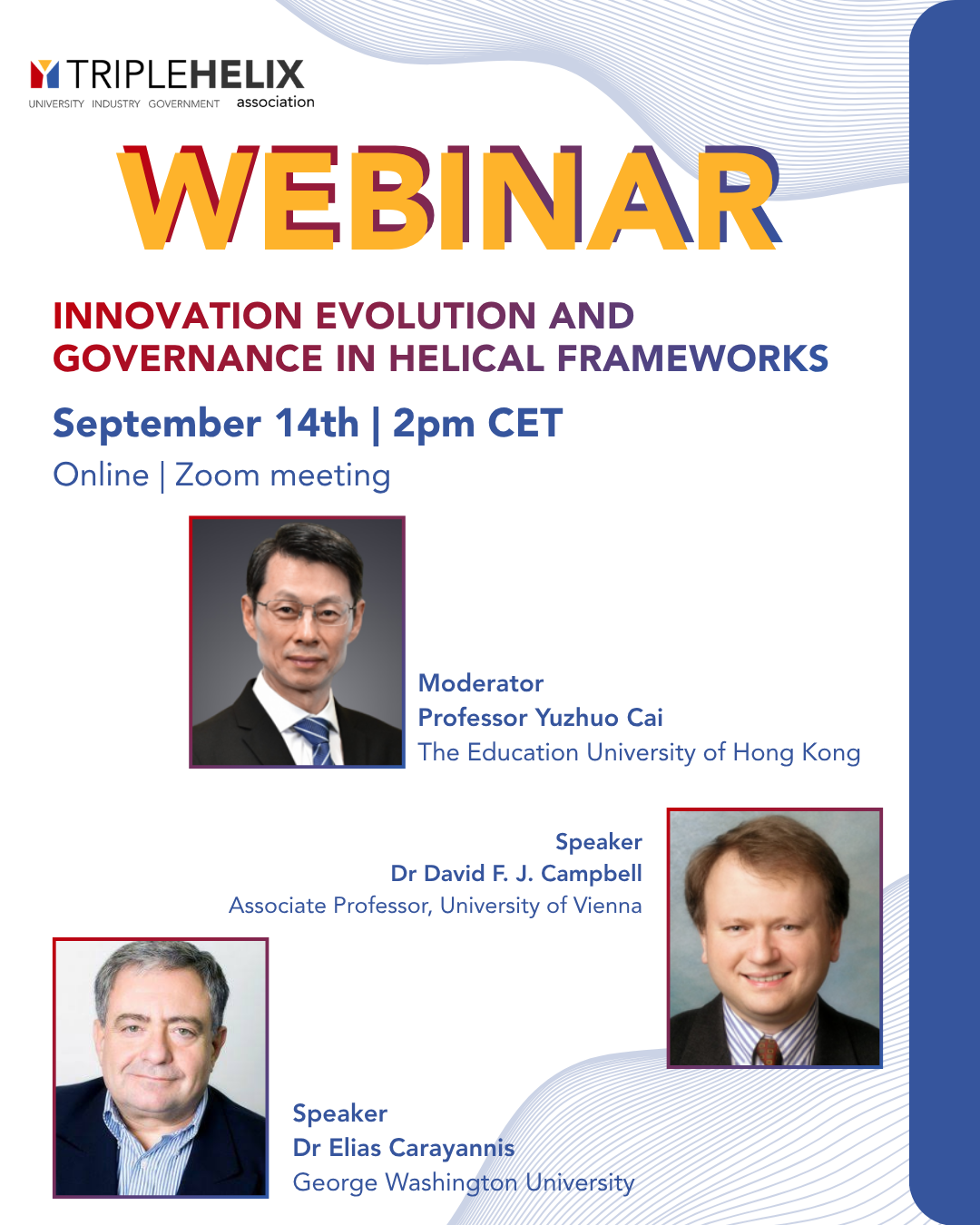
Innovation Evolution and Governance in Helical Frameworks
Entrepreneurial University, Academic Firm and Knowledge Democracies
September 14th 2026
This talk traces how innovation has evolved from linear models toward non-linear, networked and co-evolutionary ecosystems. Quadruple and Quintuple Helix frameworks extend innovation toward society, democracy and the environment, while Mode 3, Third Mission and Third Space translate this complexity into new institutional forms. Innovation thus becomes less a problem of producing novelty than a problem of governing complexity, and sustainable development further links innovation governance with democratic quality and long-term societal outcomes.
Against this background, the talk examines how the Entrepreneurial University and the Academic Firm increasingly co-evolve within interconnected knowledge ecosystems, with Epistemic Governance acting as a synthesis that connects diverse modes of knowledge and innovation. This points toward Knowledge Democracies, in which innovation, democracy and sustainability become mutually constitutive. The provocative implication is that universities and democracies alike may increasingly be judged by their capacity to govern difference without destroying it.

ABOUT THE SPEAKERS
Dr. David F. J. Campbell
Associate Professor, University of Vienna
Senior Scientist, University for Continuing Education Krems
David F. J. Campbell is Associate Professor for Comparative Political Science at the University of Vienna, and Senior Scientist and Founding Head of the Center for Higher Education Governance and Transformation at the Department for Higher Education Research, University for Continuing Education Krems. He also serves as Publication Strategist and Quality Researcher at the University of Applied Arts Vienna. Together with Elias G. Carayannis, he co-created the concept and theory of Quadruple and Quintuple Helix innovation systems and the related notions of Mode 3 knowledge production and the Academic Firm. His books include Self-Different Fractals and Innovation: Academic Firm and the Entrepreneurial University in Epistemic Governance (Taylor & Francis, 2026), Global Quality of Democracy as Innovation Enabler (Palgrave Macmillan, 2019), Smart Quintuple Helix Innovation Systems (Springer, 2019) and Epistemic Governance in Higher Education (Springer, 2013). He is Senior Associate Editor of the Journal of the Knowledge Economy and the Journal of Innovation and Entrepreneurship, and Co-Editor-in-Chief of the Springer book series Arts, Research, Innovation, and Society.

Dr. Elias G. Carayannis
Full Professor, George Washington University
Dr. Elias G. Carayannis is Full Professor of Science, Technology, Innovation and Entrepreneurship, as well as co-Founder and co-Director of the Global and Entrepreneurial Finance Research Institute (GEFRI) and Director of Research on Science, Technology, Innovation and Entrepreneurship, European Union Research Center, (EURC) at the School of Business of the George Washington University in Washington, DC. Dr. Carayannis' teaching and research activities focus on the areas of strategic Government-University-Industry R&D partnerships, technology road-mapping, technology transfer and commercialization, international science and technology policy, technological entrepreneurship and regional economic development. In addition, he serves in the following roles in European Universities and Research Centers:
· Senior Scientist, Fraunhofer-Institut für Entwurfstechnik Mechatronik IEM
· Visiting Professor, Univesitaet Leipzig
· Visiting Professor, National Technical University of Athens
· Visiting Professor, National and Kapodistrian University of Athens
ABOUT THE MODERATOR
Professor Yuzhuo Cai
Professor, The Education University of Hong Kong
Tampere University, Finland
Yuzhuo Cai is Professor in the Department of Education Policy and Leadership and Co Director of the Global Research Institute for Finnish Education at The Education University of Hong Kong. His research focuses on higher education policy and governance, universities’ societal engagement, the Triple Helix model of innovation, and innovation ecosystems. He is Co Editor in Chief of Triple Helix and Co Editor of the Journal of Studies in International Education, and has been listed in Stanford University’s Top 2% Scientist Rankings in education since 2022. He served as Principal Investigator of the Horizon Europe project NEXT UP (2025–2028), which examines youth education–employment transitions in post COVID 19 Europe and was awarded a €2.9 million grant.
RELATED RECENT PUBLICATIONS BY THE SPEAKER
- Campbell, D. F. J. & Carayannis, E. G. (2026). Self-Different Fractals and Innovation: Academic Firm and the Entrepreneurial University in Epistemic Governance. Boca Raton, FL: CRC Press, Taylor & Francis. https://doi.org/10.1201/9781315209234
- Pöcher, B., Campbell, D. F. J. & Carayannis, E. G. (2026). Innovation and entrepreneurship in organizational university “Third Space” arrangements: Third Space and Third Mission in Mode 3 universities. Journal of Innovation and Entrepreneurship, 15(2), 1–16. https://doi.org/10.1186/s13731-025-00613-6
- Campbell, D. F. J. (2026). Sustainable development and quality of democracy: 2002–2016. Sustainability, 18(17), 8842. https://doi.org/10.3390/su18178842

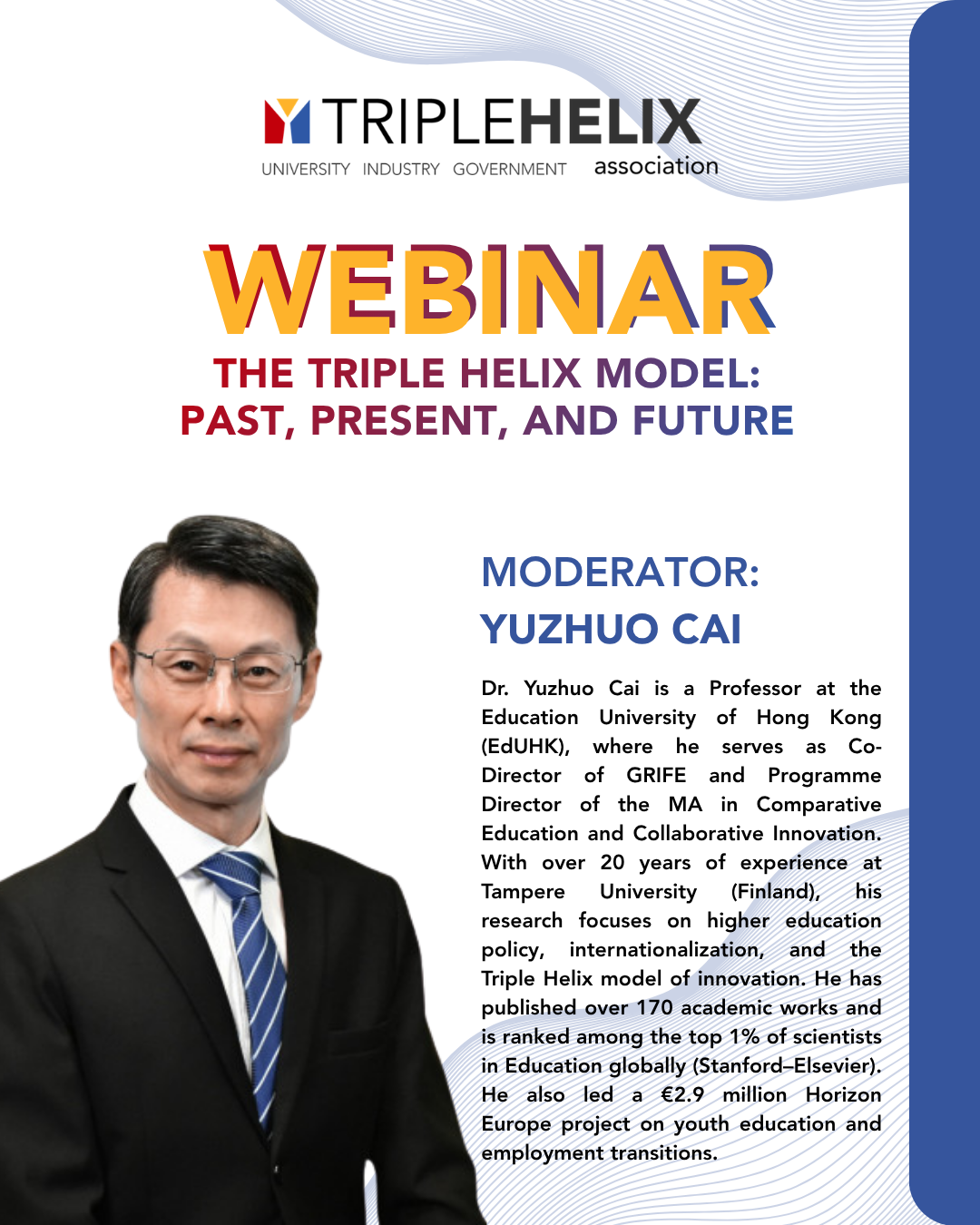
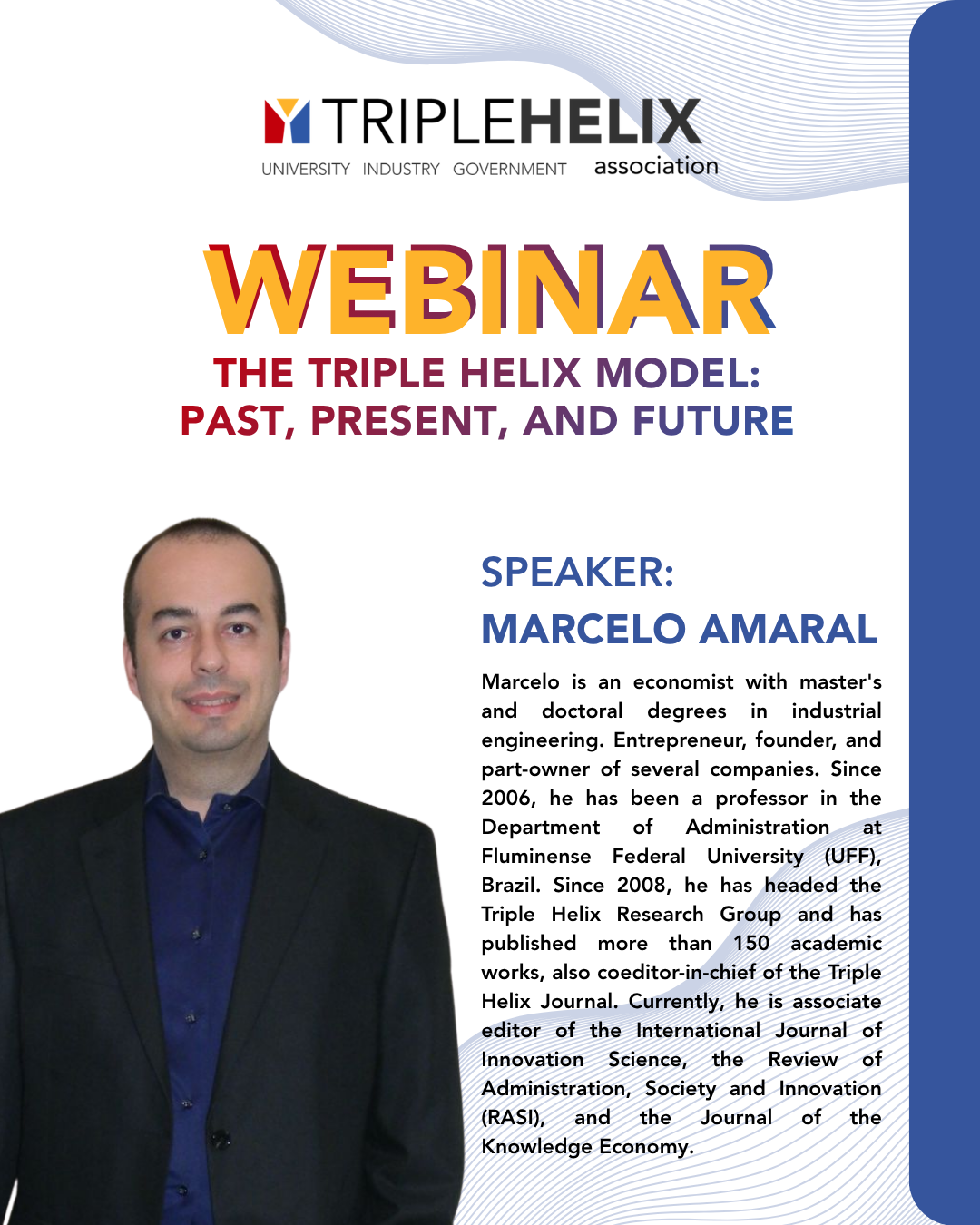
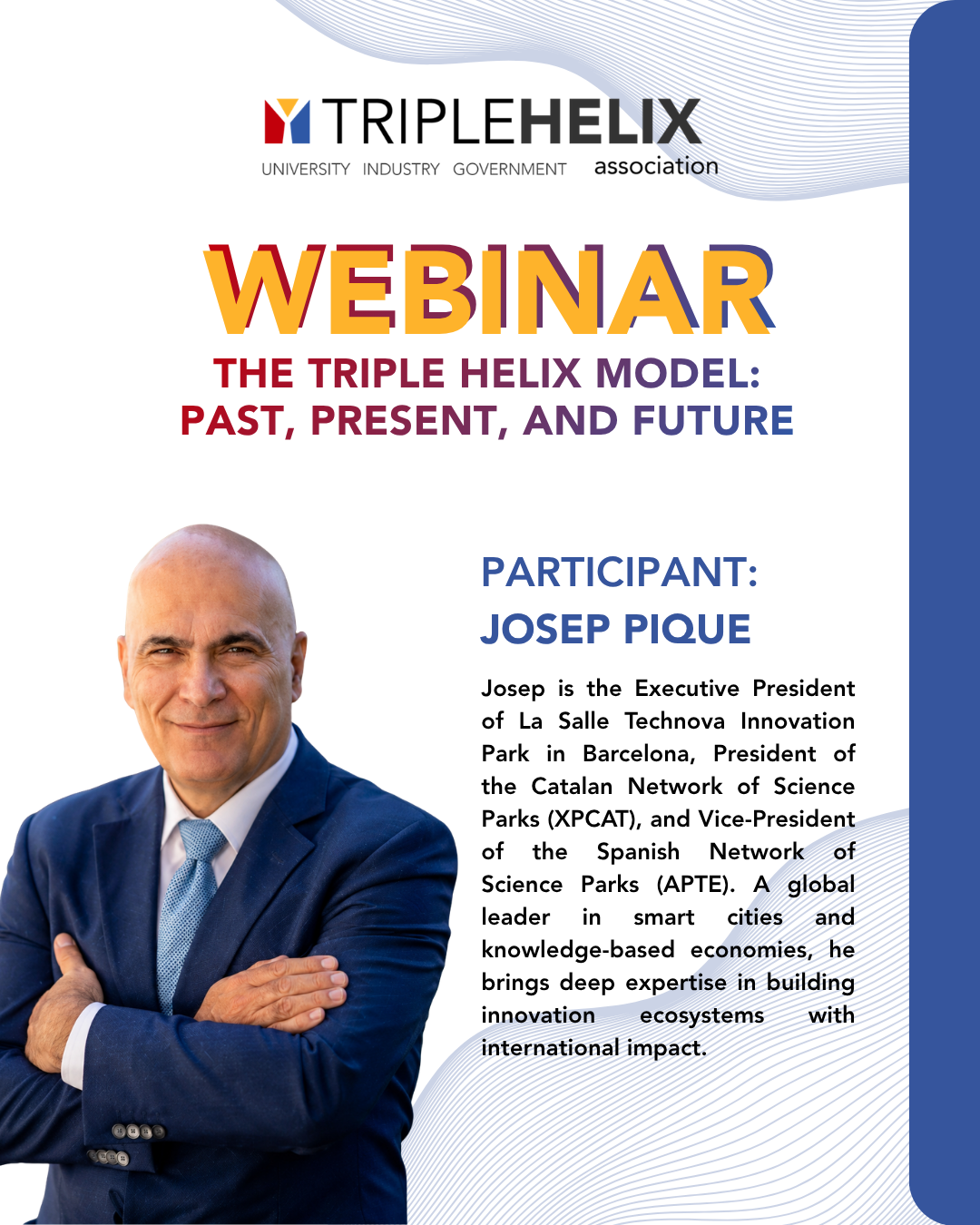
The Triple Helix Model: Past, Present, and Future
How has the Triple Helix model evolved and where is it heading next?
June 11th 2026
This webinar revisits the Triple Helix model of university–industry–government relations and asks whether helix thinking should remain triple or expand to include civil society, democracy, culture and the natural environment. Drawing on debates around Triple, Quadruple and Quintuple Helix models, the talk examines what is gained, and what may be diluted, when additional helices are introduced. Rather than treating these models as competing labels, it considers their explanatory power, theoretical grounding and relevance for sustainable innovation. The webinar will also introduce the neo-Triple Helix model, which connects innovation dynamics with social structures and environmental challenges. It will interest researchers, policymakers and practitioners working on innovation ecosystems, university–society relations and innovation governance. The session will end with an open discussion on the future of helix models.